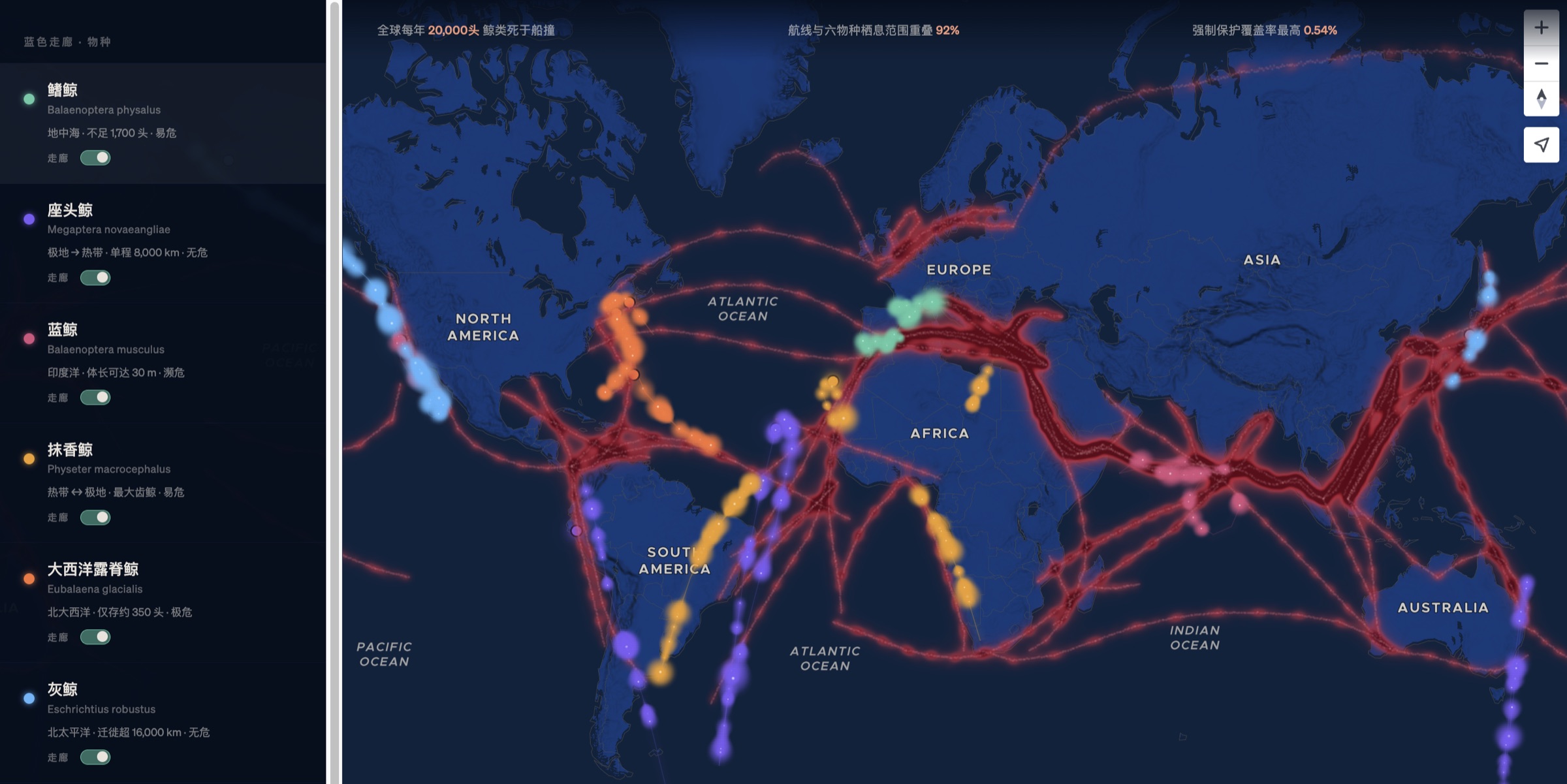
斯里兰卡南部海域是印度洋最繁忙的航运走廊之一,同时也是北印度洋蓝鲸种群最重要的觅食和聚集地。科学研究证明,只需将现有航线向南移动 15 海里,就能将蓝鲸面临的碰撞风险降低高达 95%。这个方案存在已近十年,至今没有成为官方规定。
The waters off southern Sri Lanka are one of the busiest shipping corridors in the Indian Ocean — and also the most important feeding and aggregation site for the northern Indian Ocean blue whale population. Independent science has demonstrated that simply moving the existing shipping lane 15 nautical miles south would cut blue whale collision risk by up to 95%. The proposal has existed for nearly a decade. It has yet to become official.
一条致命的重叠
A Lethal Overlap
斯里兰卡南部米里沙(Mirissa)附近海域,是北印度洋蓝鲸种群密度最高的区域之一。每年,蓝鲸在此觅食、社交、休息——而穿越印度洋连接欧亚大陆的主干航线,正好从这片海域的核心地带通过。
The waters off Mirissa, on Sri Lanka's southern coast, host one of the highest densities of blue whales in the northern Indian Ocean. The whales feed, socialize and rest here year-round — and the main shipping route linking Europe and Asia runs directly through the heart of the same waters.
斯里兰卡鲁胡纳大学、IFAW、生物圈基金会和印度野生动物信托基金于 2014 至 2015 年联合开展的实地调查显示:
Joint fieldwork by the University of Ruhuna, IFAW, the Biosphere Foundation and the Wildlife Trust of India in 2014–15 documented the following:
- 现有东向航道内,蓝鲸平均密度达每平方公里 0.1 头
- Mean blue whale density inside the eastbound lane: 0.1 individuals / km²
- 西向航道峰值船舶密度达每年每公里 1,090 艘次
- Peak vessel density in the westbound lane: 1,090 transits / km / year
- 蓝鲸密度最高区域与船舶密度最高区域完全重合
- The peak whale-density zone fully overlaps the peak vessel-density zone
研究人员 Ranil Nanayakkara 2017 年的调查显示,斯里兰卡水域记录在案的大型鲸类死亡中,近一半与船撞有关。
A 2017 review by Ranil Nanayakkara found that close to half of all documented great-whale deaths in Sri Lankan waters can be linked to vessel strikes.
一个简单的解决方案
A Simple Solution
2015 年发表于《区域海洋科学研究》(Regional Studies in Marine Science)的论文明确指出:如果将现有航线向南偏移 15 海里,通过当前鲸类密集区以南更深海域,蓝鲸面临的碰撞风险将降低 95%。
A 2015 paper published in Regional Studies in Marine Science spelled it out: if the existing lane were shifted 15 nautical miles south, into deeper waters below the current high-density zone, blue whale collision risk would drop by 95%.
对于跨越整个印度洋的船舶而言,15 海里的绕行距离几乎可以忽略不计。
For vessels crossing the full breadth of the Indian Ocean, a 15-nautical-mile detour is negligible.
"一个严重的鲸类威胁能如此容易地得到解决,
并且以极低的代价——这种情况并不多见。
我们不仅清楚地看到了问题,
还有一个直接可行的实际解决方案。"
"It is rare for a major threat to whales to have such an easy fix,
at such a low cost.
We don't just see the problem clearly —
we have a direct, workable solution sitting on the table."
行业先行,政府滞后
Industry Has Moved. Governments Have Not.
2022 年 9 月,全球最大集装箱航运公司地中海航运公司(MSC)宣布,已主动将其过境斯里兰卡的航线向南偏移 15 海里,同时将船速限制在 10 节。MSC 表示此举是在 OceanCare 和 IFAW 的建议下做出的。
In September 2022, the world's largest container-shipping company, Mediterranean Shipping Company (MSC), announced that it had voluntarily shifted its Sri Lanka transit route 15 nautical miles south and capped vessel speeds at 10 knots. MSC stated the move was made on advice from OceanCare and IFAW.
这是迄今为止最大规模的单一航运公司保护行动。然而,这一改道方案至今仍属自愿性质,未能成为 IMO 认可的官方航线。约 25% 的过境船舶已自愿采用南线,其余 75% 的船舶仍沿原有路线行驶。
It is the single largest conservation action ever taken by a shipping company. But the diversion remains voluntary; it has never been adopted as an official IMO-recognized route. Roughly 25% of transiting vessels are now using the southern line. The remaining 75% still run the original route.
多年来,IWC、世界航运理事会(WSC)以及多家主要航运公司,已多次联名致信斯里兰卡政府,呼吁其向 IMO 提议正式调整航线。呼吁至今未获回应。
For years, the IWC, the World Shipping Council (WSC) and a coalition of major shipping companies have jointly written to the Sri Lankan government, urging it to submit a formal lane-shift proposal to the IMO. Those letters have so far gone unanswered.
"改道是为斯里兰卡蓝鲸带来转机的关键希望。
这也向斯里兰卡政府表明——
是时候采取适当行动,
为所有商船将航线移出蓝鲸栖息地了。"
"Re-routing is the key hope for turning a corner for Sri Lanka's blue whales.
It also signals to the Sri Lankan government
— it is time to act,
and move every commercial vessel out of blue whale habitat."
事件时间线
Timeline
一个等待中的答案
An Answer, Still Waiting
斯里兰卡蓝鲸的案例,是全球船撞议题中最清晰的一个:
Sri Lanka's blue whales are the cleanest case in the global ship-strike debate:
- 问题已被科学精确定位
- The problem has been precisely localized by science
- 解决方案已被反复验证
- The solution has been repeatedly validated
- 行动成本极低,对航运几乎无影响
- The cost of acting is negligible — almost no impact on shipping
- 行业头部企业已率先示范
- The largest player in the industry has already led by example
官方层面的改变,依然没有发生。
Officially, nothing has changed.